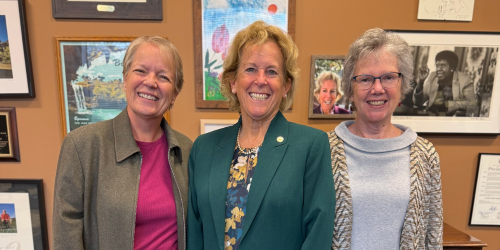
INTERVIEW WITH ANN HOWARD, TRAVIS COUNTY COMMISSIONER
12-17-2025, Grace Chimene, Commissioner Ann Howard, Susan Hart
The League of Women Voters is a non-partisan organization. We never support or oppose any political candidates or parties, but we do advocate on issues that we have studied and on which our members have understanding and agreement. The Advocacy Committee of the Austin Area League visits local elected officials to share information about the League and its positions as well as to learn more about what our local region's elected officials see as key issues and priorities.
This interview with Travis County Commissioner Ann Howard is part of a series of interviews with local elected officials during 2025 and 2026.
Getting to Know Travis County Government
Travis County is governed by a group of elected officials: four commissioners, each representing a geographic region of the county, and a county judge. Together, they make up the chief policy-making and administrative branch of county government.
Among its many functions, the court:
- sets the tax rate,
- determines fees for many county services, and
- determines how the collected revenues will be distributed among different county departments to provide services to the community.
You can view Travis County’s 2026 Budget in Brief here.
Travis County Commissioner Ann Howard was first sworn in as the County Commissioner for Precinct 3 on January 1, 2021 and re-elected in 2024. Her precinct includes the entirety of the University of Texas main and west campus areas, and also from downtown Austin to Briarcliff, out west on SH 71 and Jonestown on SH 1431, including neighborhoods of Westlake, Rollingwood, Circle C and Lakeway. Howard is the former executive director of ECHO, the Ending Community Homelessness Coalition, is a graduate of UT Law and LBJ Schools, and a former attorney on the US Senate Judiciary Committee. She is passionate about affordable housing and smart development, giving special attention to preserving our water resources.
Q: What first drew you to public service, and specifically to county government?
I’ve always been wired for public service. From student government to PTA work, I’ve gravitated toward policy, problem-solving, and systems-level work. Professionally, I worked in the nonprofit world—most notably on homelessness—which gave me a front-row seat to how local government really functions. When a seat on Commissioners Court opened, I saw an opportunity to bring that experience into elected service.
Q: What would you like voters to understand better about Travis County government?
County government is effective, efficient, and increasingly important, as state and federal support becomes less reliable. The County has successfully directed tax-payer investments in transportation, parks, childcare, after-school programs, affordable housing, and homelessness services. We are continuing to strengthen partnerships with the City of Austin and nonprofits to see where we can collaborate and expand our resources. By improving city-county collaboration, we can also better serve residents by directing them to where they will get answers. People don’t care who does the work; they just want it done.
Q: What are some of the challenges facing Travis County in the coming years?
Overall, we are dealing with uncertainty: we’re facing lean budgets, unknowns at the federal level, and limits on local authority imposed by the state. This is a time to be strategic and thoughtful. With that in mind, we are addressing some specific issues:
- Affordable child and afterschool care: in 2025, Travis County launched a newly branded and voter-approved childcare fund program, Raising Travis County, aimed at reducing the childcare waitlist and improving care quality countywide.
- Affordable housing: the County has contracted to construct ten new supportive housing developments to make homelessness rare, brief, and non-recurring. In addition, the County invested in Austin Habitat for Humanity to develop 48 affordable homes in Eastern Travis County. These homes will come with a 99-year affordability covenant to ensure that they remain affordable.
- Enhanced criminal justice system: the County is one of 7 in Texas that has implemented some form of Counsel at First Appearance (CAFA). Travis County is meeting its goal of having 100% of people booked into jail represented by a lawyer for their first appearance in front of a judge. In partnership with the City and non-profits, the County is also participating in the Crisis Care Diversion Pilot which diverts people from jail, when appropriate and safe, to mental health treatment.
- Water and land conservation: Water is our most precious resource. Development pressures, outdated state water laws, and climate change are putting enormous strain on our rivers and aquifers. The County can play a role to ensure that the generations ahead of us all have access to water. For example, the County entered into a historical settlement to preserve the groundwater feeding Hamilton Pool. This is the sort of mindset that drives the County to collaborate with groundwater districts and homeowners associations to protect groundwater across the County. The County has also worked hard to preserve thousands of acres of parkland through conservation easements and land purchases. These are long-term investments that will benefit generations.
Q: How can residents get involved or help the county’s work?
There are many ways. Residents can:
- volunteer to serve on county boards and commissions,
- help lead water conservation and wildfire preparedness efforts in their neighborhoods, and
- stay informed and share accurate information. Civic engagement—at every level—makes our community stronger.
Q: What gives you hope right now?
Our staff, first and foremost. They are smart, committed, and deeply dedicated to public service. We are working on career ladders and compensation models to retain and attract dedicated people. I’m also encouraged by growing civic engagement—especially among young people and longtime residents who are getting involved for the first time. Even in challenging times, people care deeply about their community, and that gives me hope. We are here to work together.
For more information about Travis County government, volunteer opportunities, or how to contact your County Commissioner, visit the Travis County website or follow Travis County on social media.